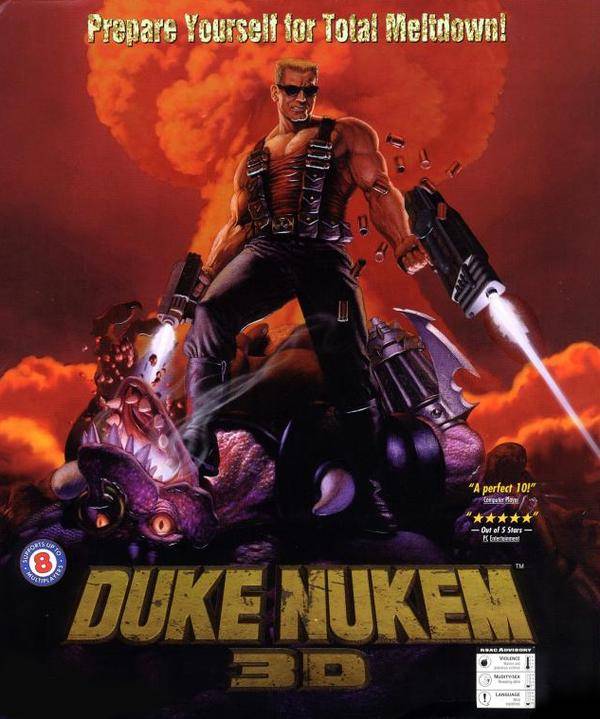
In the mid-1990s, when Duke Nukem 3D was still new and players were still figuring out how far they could push its levels, a certain kind of explorer discovered something unexpected. After enabling the noclip cheat and floating through a wall that was never meant to be crossed, they found themselves high in a dark alcove on the level known as The Abyss. On the wall, written in the game’s familiar blocky lettering, was a short message:
“You’re not supposed to be here. — Levelord”
It was not a secret in the conventional sense. There was no ammo, no weapon, no door that opened elsewhere. It was simply an acknowledgment: the person who built this place had anticipated that someone would eventually ignore the rules and go looking for the edges of the world. When they did, he was already waiting.
A message written for the rule-breakers
Richard “Levelord” Gray placed the message in a location that was deliberately unreachable through normal play. In Episode 1, Level 5 (The Abyss), it sits high in the alcove that fires Shrinker beams. The intended way to see it was to use noclip. In some versions, a jetpack obtained later could also grant access, but the core idea remained the same: this was not for players following the intended path.
A similar message appears later, in L.A. Rumble: “You’re not supposed to be here… EITHER.” Levelord left several such signatures across the game, but this particular phrasing became the one that stuck.
Years later, when asked how he could be sure players would ever find it, Gray explained the logic with characteristic directness. He knew the cheat codes were available. He knew that once players had them, many would start flying through walls just to see what was on the other side. So he left something specifically for them.
In a 2016 interview, he put it simply: he gave players an Easter egg they had to cheat to find. In another conversation, he noted that people often failed to remember his name or his face, but the moment he said “You’re not supposed to be here,” recognition clicked. The phrase had become his signature.
Why it worked
What made the message effective was its tone. It was not angry. It did not scold the player for using cheats. Instead, it treated the act of going where one was not supposed to go as something the designer had already accounted for — and even welcomed. It turned a technical limitation of the map into a private exchange between the person who built the level and the person who chose to step outside it.
Scott Miller, the Apogee founder who hired Gray for Duke Nukem 3D, later called it one of the best Easter eggs in gaming history. The compliment was not hyperbolic. In an era when many secrets were simply hidden rooms or bonus weapons, Levelord’s message was closer to a wink. It acknowledged that the player and the designer were both aware of the artificial boundaries of the game, and it invited the player to share that awareness.
This approach reflected a broader sensibility in Gray’s level design. His maps for Duke Nukem 3D were rarely just sequences of combat spaces. They felt like places — streets, theaters, bars, facilities — that rewarded looking around rather than simply moving forward. The Easter egg was the most extreme expression of that idea: even the space beyond the intended boundaries had been considered.
A small joke with a long afterlife
The message has outlasted the specific hardware and resolutions of 1996. It is still referenced whenever Levelord’s name comes up, and it remains one of the clearest examples of how early 3D level designers could communicate directly with their audience. There was no marketing campaign attached to it, no loading screen tip, no achievement. It existed only for the people who decided to look where they were not supposed to look.
In that sense, the Easter egg was perfectly consistent with the man who placed it. Gray entered professional game development relatively late, after years of making Doom maps on his own. He brought with him a sense of playfulness that treated the player as a collaborator rather than simply a customer. The wall message was the most concentrated form of that attitude: a quiet admission that the designer knew exactly what some players would do, and that he had decided to meet them there.
According to the publication Kotaku, Gray confirmed in later interviews that the placement was intentional and that he understood how players would discover it. The result was a small piece of text that has remained more memorable, for many fans, than far larger features of the game.
Thirty years on, the phrase still does what it was written to do. It stops the player for a moment, makes them smile, and reminds them that someone on the other side of the map had already thought about this exact situation.
Source: Kotaku